Showing posts with label war. Show all posts

Thursday, 9 February 2017

Southport's Holocaust Memorial service


The Holocaust Memorial service, presided over by Michael Braham, was one of the most compelling and powerful remembrances for the victims of genocide held in our town.

Young people from the VIth Form Colleges at KGV and Runshaw joined the pupils of St John's Ainsdale in reminding us of the enormous human cost of the holocaust. They told the stories of individual victims, those who had died and those who lived on after the war. Their thoroughly researched presentations had a great emotional impact.

Their contributions were followed by the Imam of Southport Mosque Soyful Alam. The packed congregation, in Christ Church on Lord St, had listened in respectful silence to the young people and to Michael Braham talk about the events that took place in the death camps of Nazi Germany and of the plight of refugees -especially the children- who came to this country and our town. The history they related addressed the theme of the service; how after the genocide can life go on.

pupils from St John's Ainsdale re enact a scene where children disembark from the kindertransport

Into the silence stepped Soyful to take his place behind the lectern. His powerful address confronted the continuing use of genocide in the world today. He spoke of his despair and our failure to learn the lessons of the holocaust. The world stands aside and fails to act. It is hard to find hope when night after night we see images of genocide and we know how many hundreds of thousands of people have been killed. Soyful warned this failure to act undermines our common humanity and the bonds that should link us all together.

Such was the impact of Soyful's address that the congregation broke in spontaneous and prolonged applause and in the tea room after the service it was the main topic of conversation.
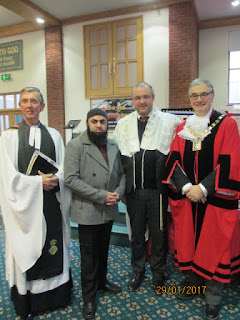


Peter Dowd MP's was unable to attend the service and I was asked to say a few words. As world events are played out and once again the warping influence of nationalism and populist politicians threaten the peace and stability of our world it is more important than assert our values. One of my responsibilities as Mayor is to preside over Citizenship ceremonies during which we declare our allegiance to the British values of respect and tolerance. We must fight intolerance and prejudice wherever we encounter it. The Holocaust was an indescribable atrocity, and we must never forget the victims of this evil and those other acts of genocide that continue to this day. The work of Holocaust Memorial Day keeps alive the memory of those who died and those who survived.  We own a great debt to those who dedicate themselves to educating the public. One such person is Pauline Collier (pictured above with the pupils of St John's), who is a Fellow at the Imperial War Museum. She has been central to the success of the Southport Holocaust Memorial service as long as I can remember. Thanks to her and those who work alongside her the next generation have been taught about the terrible event that took place.


Sunday, 4 December 2016

Waterloo man presented with Legion d'Honneur

Presenting John Shankland with the Legion d'Honneur

It was a genuine pleasure to meet John Shankland, who lives in Waterloo, and present him with the Legion d'Honneur on behalf of the French Government in grateful recognition for his part in the Liberation of Europe.

John was a regular soldier and before the war was stationed in India. He was at Dunkirk and finished the war with the British detachment at Beslen. I met his Grandson who had accompanied him a recent visit back the the battlefields of WW2.

At the end of the war John came to work fro Crosby Council and became the Mayor's chauffeur a post which he held up until 1984. I was a member of the council back thaen and recall that all the Mayoral staff were real 'characters'

I have presented one of the medals to a Southport man Ernest Jones and on that occasion I read out the citation from the letter that accompanied the medal. I did so again:

 As we contemplated this Europe of peace, we must never forget the heroes like you, who came from Britain and the Commonwealth to begin the liberation of Europe by liberating France. We owe our freedom and security to your dedication, because you were ready to risk your life.'

Two events to commemorate Captain Johnny Walker UK's leading wartime submariner

The memory of Captain Johnny Walker is cherished in these parts. He was a real war leader whose innovative approach to hunting down U-boats in the Battle of The Atlantic made a real difference to saving allied lives and providing a much safer passage for the all important arctic convoys.

The day began with a service in Bootle Town Hall. Capt Walker was based in Bootle's Gladstone dock and when he laid up the flags from his boats including HMS Wildgoose, Starling and Stork along with other items he chose to do so in Bootle Town Hall. Generations of local school children have learned about his exploits. His grandson Patrick was among the naval personnel past and present who attended the service which was led by the naval chaplain Fether David Gamble.
Father Gamble, IBB, Patrick Walker an the RM Officer commanding HMS Eaglet

Most prized of all the memorabilia is the General Chase Flag. We tell those undertaking the tour of the Town Hall that it has only been flown three times in history, once by Sir Francis Drake, when he chased the Spanish Armada from the Channel in 1588, and again by Nelson when he defeated Napoleon’s fleet at the Battle of the Nile in 1798. In our version of history, the third time ever that the flag was flown was On 30 July 1943,when Walker's  2nd Support Group encountered a group of three U-boats on the surface while in the Bay of Biscay. Captain Walker signalled "General Chase" to his group and fired at the U-boats, causing damage that prevented them from diving. Two of the U-boats were then sunk by the Support Group and the third by an Australian flying boat. “General Chase” is signalled to release ships from a line of battle, or other formation, in order to pursue a retreating or beaten foe.  I have subsequently discovered that is not strictly true because, at the Battle of the Falkland Islands on 8 December 1914, Sturdee hoisted General Chase at the beginning of the action. I have to say as the day went on and I attended the Captain Walker Dinner on HMS Eaglet I discovered that quite a few of the 'facts' we impart on these tours are not strictly true.


The commemoration of  Captain Walker moved on to a mess dinner in the evening. Instead of celebrating Trafalgar Day the University Royal Navy Unit (URNU) Liverpool holds a Johnny Walker Dinner. The senior student this year who presided over the meal was Chris Vroom. Between each courses, he called on one of his colleagues to tell the story of Captain Walker's exploits. In many ways it felt like a scene out of Beowulf. You could easily imagine sitting around the fire in the Mead Hall in Heorot listening to how Beowulf defeated the monster Grendel.

First up Chris Vroom set the scene

Ladies and Gentlemen, welcome to Liverpool University Royal Naval Unit’s Captain Johnnie Walker Night Dinner. This evening we will share with you the story of the Battle of the Atlantics most successful anti-submarine warfare commander.


Convoy HG76 sailed from Gibraltar on December 14th 1941, 7 days after the attack on Pearl Harbour. Its 32 ships were arranged in the standard column formation, with the 36th Escort Group providing protection through HMS Stork, HMS Depthford and 7 flower class corvettes, with the then Commander F J Walker in command. Three destroyers and escort carrier HMS Audacity would join this force later. Against established routine, Walker arranged his ships in two screens, one close to the convoy and one much further out. This meant that for the first time, U boats would encounter the escorting warships before being able to close and attack the convoy. It was risky, but Walker was confident.

After the first course we moved on to the second installment of the story-which is where I discovered we were handing out 'duff' information to the visitors to Bootle Town Hall.This part was retold by Chris C

At 0900 hrs on the 17th December, an aircraft reported the U-131, 22 miles astern of HG76 and forced it to dive. The U-Boat was seen on the Stork's radar and Walker decided to test his so far unproven theory of offensive escorts. Taking HMS Stork and his 3 additional destroyers, he raced back along the convoy track towards U-131. Faulty hydrophones failed to inform the submarine of the approaching danger and the destroyers damaged the U-Boat with depth charges, but it remained submerged. 


Walker then formed a search line and began to hunt. About two hours later, the submarine surfaced and was immediately spotted. Walker ordered the attack. Sub Lt Fletcher in his Martlet aircraft dived on the U-Boat but was shot down and killed. His body was later recovered by Walker. After 20 minutes of shellfire U-131 abandoned ship. After collecting survivors, Walker had his first kill. That same afternoon a second submarine was sunk by the outer screen. Two U-Boats sunk and thus far, no losses.

Before part three I should pause to say that the food was excellent and the wine plentiful-but I was holding myself for the port.. Aoife Richardson told us of the night he sank four U-boats.

At 0400 hrs on December 19th; U-574 spotted and torpedoed HMS Stanley. Walker ordered his team to use a pre-arranged plan known as "Buttercup". As one they turned away from the convoy firing starshell, forcing the U-Boat to dive, hence allowing HMS Stork to pinpoint her on ASDIC and launch a combined ramming and depth charge attack, crippling the submarine.

That night HMS Audacity took up her night position away from the convoy and was torpedoed by U-751. Despite a desperate search the U-Boat was not found. However, HMS Deptford sighted a U-Boat on the surface and together with HMS Stork successfully attacked it with depth charges. A second submarine was also damaged.

By now the escorts were running low on ammunition and damage was mounting. HQ Western Approaches sent two destroyers and coordinated air cover to finally see the convoy home. In London the Admiralty was delighted; 4 U-Boats sunk and one badly damaged for the loss of 2 merchantmen, an escort carrier and a destroyer. 

Thanks to Walker's tactics, they now admitted a major rethink was needed in the Atlantic.

We now move to the more escoteric naval customs. A glass of port was poured and placed on the table next to the painting and bust of Johnny Walker. We then had the l

oyal toast-in these parts 'the Queen, the Duke of Lancaster.

No 1
Things then got very strange. Chris Vroom stood and declared: 'Can all those who have created vessels in honour of this evening please parade. Ladies and gents can you all please make note of the one you believe would be the biggest adversary to the U-Boats'
No 2
No 3


We were then asked the cheer for the vessel we favoured. It will come as no surprise to those who remember Boaty Macboatface that the small chaocolate swiss roll representing a torpedo (I presume) won.

Monday, 21 November 2016

Curry Lunch at the R G Masters VC Barracks

After calling into the Comrades Club in Crosby after the Act of Remembrance at Southport Cenotaph I went to have a Curry Lunch with the Army Reservists. This event was held at the  Private R G Masters VC Barracks. Pte Masters was a Southport lad who won the VC in WW1.

First up I should say that both the curry and the company was excellent. It was only a fleeting visit but I was pleased that we had agreed to do it. Increasingly our defence capability relies on reservists and it is important we recognise their contribution.

I was impressed by the calibre of the people I met. I was introduced to two engineers whose day jobs were at Bentley in Crewe and at Jaguar Land Rover in Solihull. Their dedication to their army was impressive.


Thursday, 8 September 2016

Unveiling Bootle War Memorial

photo by K Hodgson
On an extremely wet Saturday morning a large crowd came and stayed for over an hour for the rededicating of the restored Bootle War Memorial.


The work had been founded by a variety of sources including a large donation from the War Memorial Trust . This is one of the biggest grants made by the Trust.

Despite the rain everyone listened attentively as the memorial was dedicated. The ceremony was a recreation of the one carried out in 1922 with the laying of wreaths
I concluded the event by repeating the pledge made back then by the then Mayor that the council would look after the memorial. The vicar of Christchurch Bootle blessed the memorial and we sang familiar hymns including all seven verses of Abide with Me. (Who knew Abide with Me had seven verses? Well one older member of the gathering impressively sang all the verses from memory!). We were to accompanied by the Formby Band  
phot by K Hodgson


The order of service for the rededication describes the monument thus:

The design of the memorial is based on a suggestion from the War Memorial Committee that all three services should form an important part of the design and that the names of the fallen heroes should be recorded. The overall form and configuration of the memorial was proposed by Hubert Ernest Bulmer, ARCA (1874-1963), who was the County Borough of Bootle's Art Director and had previously been head of the Bootle School of Art (which was a predecessor to the Hugh Baird College of today).
a representative of the War Memorial Trust

The memorial is constructed from Forest of Dean sandstone and comprises a twelve-sided base on two circular steps, which have bronze panels with the names of those remembered inscribed between pilasters. Above this base is a triangular, concave-sided obelisk that supports a bronze depiction of a mother and child. Flanking the obelisk on three sides are figures of an infantry soldier, a sailor and an airman. The total height of the memorial is 20 feet.

The memorial sits within a wide paved landing and is surrounded by an outer ring comprising a dwarf wall with coping stones beyond which the landscaped setting includes a perimeter privet hedge and lawns.

There are 12 bronze plaques upon which are the names of 1007 Bootle men killed in the First World War. The bronze sculpture depicts a soldier, sailor and an airman, three laurel wreaths and a stature of a mother holding a baby.
The bronze sculptures are by Joseph Hermon Cawthra, RBS (1886-1971) and were cast by Mario Manenti (1885-1954), a bronze founder and an artist who ran a foundry at 416 Fulham Road, London between 1921 and 1928.


The inclusion of an airman is very unusual for a First World War memorial as air warfare was still very new and only a few war memorials of this age include an airman. He stands on the east side of the memorial and is looking up to the sky. The sailor and soldier figures are shown guarding a mother and child figure which symbolises new life and hope.

The sculptor Cawthra's later career was largely based on his reputation following Bootle War Memorial. Before they were installed on the memorial, his bronze figures were exhibited at the 1922 Royal Academy and received admiring comments with positive reviews recorded in contemporary accounts at the time. Critics praised the realism of the Tine colossal bronzes' with one critic praising the 'virility' of the airman figure and writing 'it is indeed a tonic to see these rugged warriors in place of the usual classical nymphs'. Later, Cawthra described the airman figure as one of his best works.
Construction work began in May 1922 and the completed memorial was unveiled on the 15th October of that year. The contractor was Harry Clegg from Chester.

The Bootle Times printed a very detailed account of the official unveiling ceremony which took place where we are now stood on 15th October 1922 and according to the article, 'this was attended by tens of thousands of onlookers and in glorious sunshine.

In 1948 permission was granted by the Council for the addition to the memorial of the names of servicemen killed in the Second World War. This consisted of alterations to the entrance steps to incorporate two additional bronze plaques and the addition of further names to the original stone boundary plinth. They also added a stone tablet commemorating the Liverpool Escort Force which protected the vast convoys of merchant ships which brought food and materials to this country via the docks, upon which so many people in Bootle depended.

Since the Second World War further names from subsequent conflicts, have been added, with the most recent being added earlier this year.

This Memorial is still very much a monument to the people who gave their lives, including those from our own generation and they will always be remembered.

Brave Bootle man awarded #VC commemorated-- with added photos


photo by Keiran Hodgson

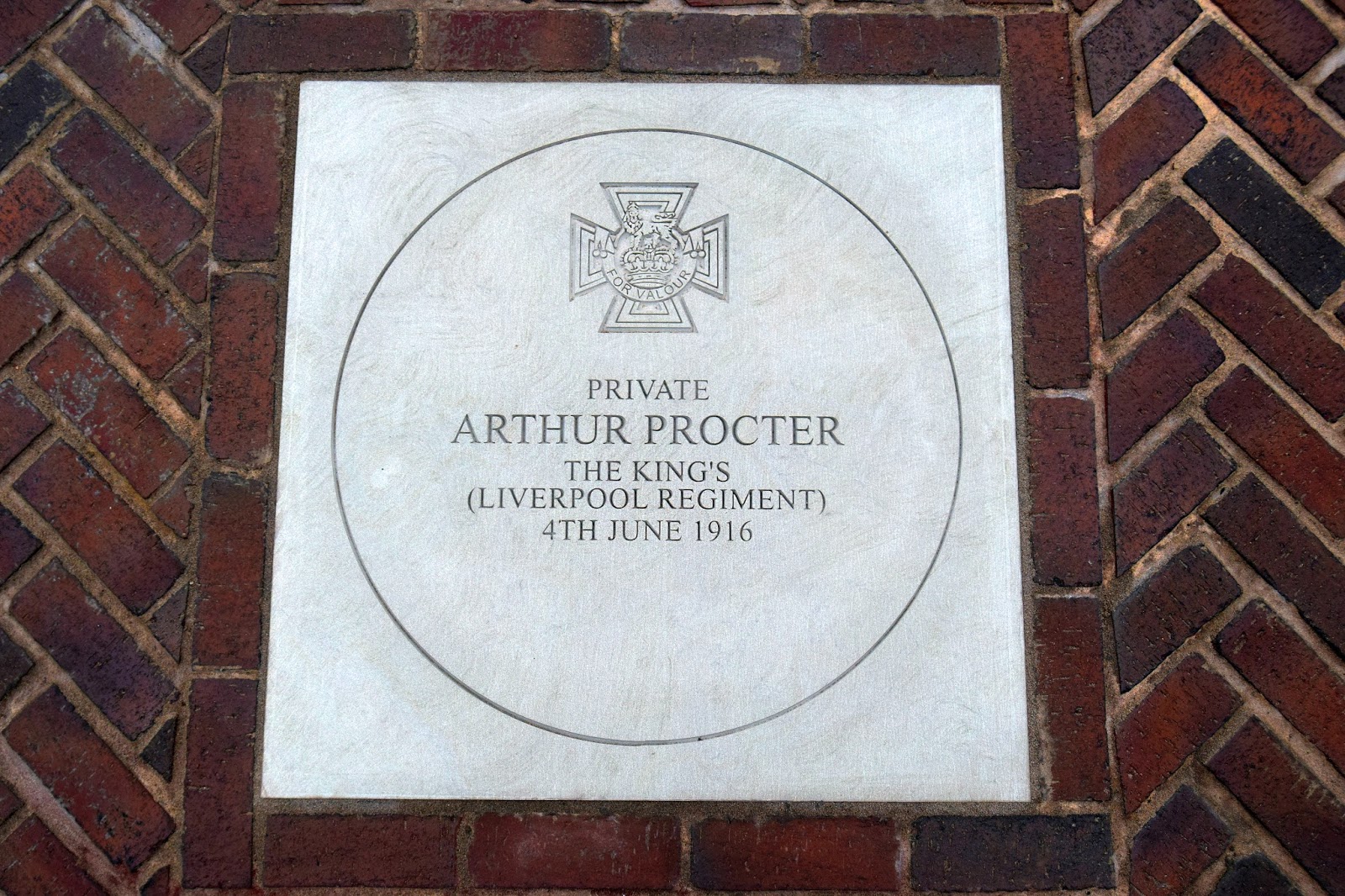
We gathered in the rain at the newly refurbished Bootle War Memorial to rededicate it and to unveil a separate memorial to a brave Bootle man who won the VC in WW1

Arthur Herbert Proctor was born in Bootle in 1890. He was the first man to be decorated with the VC on the battlefield. Private Proctor was given his medal for outstanding bravery. The citation reads:


photo by Keiran Hodgson

photo by Keiran Hodgson
I was pleased to meet members of his family including his granddaughter who spoke movingly at the ceremony. She had travelled from Yorkshire to attend the unveiling and spent this week in Southport on holiday. Arthur Proctor lived a full life. He died in 1973. After WW1 he took holy orders and served in various parishes including at Prescot and Cheshire and Shropshire. In retirement he settled in Sheffield and his ashes were buried in the Cathedral.


The family had a fund of stories about him. Three stories stood out. Two generations told of his love of getting them around the piano to sing the chorus; I'm H.A.P.P.Y.

In WW2 he served as a chaplain to the RAF, three of his relations told me the same story. He was travelling by train in his clerical uniform when he struck up a conversation with a young women in his carriage, He asked what she did. She replied that she was a singer. Keen to help the young women he said he would do what he could to get her a concert at his camp. They exchanged contact details she giving him the address of her agent. On leaving the train he was met by his wife who had to explain to him that the singer he was travelling with was Vera Lynn.

The third episode they all recalled related to a photograph of him in Africa sometime in the 1960's holding an African shield. We learned during the morning that along with other holders of the VC he was invited to be on board a VC10 on its inaugural flight to East Africa. Against medical advice he took up the offer and that is where he met President Jomo Kenyatta and the photograph was taken. 
photo by Keiran Hodgson
Private Proctor had a heroes welcome when he returned to Bootle. There are newspaper reports of him being carried shoulder high through the streets and of him get a cheque for £600 from the Mayor. I was told that it was unusual for Privates to get the VC. Proctor returned home and went on to live a full life. Others were not so fortunate. Many men returning from the trenches were haunted for the rest of their lives by their experience. Mental Health services and charities expanded of WW1 and 'shell shock' and other effects of the war were treated rather than being seen as examples of a lack of  'moral fibre'. Around the time of the unveiling of the Bootle War Memorial another exceptional Private was being treated in Lord Derby's hospital that served the town. He was Ivor Gurney. Unlike most of the celebrated war poets he was not an officer. Before the was he was seen as one of the brightest musical composer in the UK and was described as the English Schubert because of his highly acclaimed song writing. Listening to the story of Private Proctor I think he would have concurred with Gurney's sentiment in his poem Requiem


Pour out your light, O stars, and do not hold
Your loveliest shining from earth’s outworn shell
Pure and cold your radiance – pure and cold
My dead friends face as well.

Requiem

Pour out your bounty moon of radiant shining
On all this shattered flesh, on all these quiet forms;
For these were slain, so quiet still reclining
In the noblest cause was ever waged with arms. 

Friday, 1 July 2016

The Battle of the Somme commemoration Southport 2016

This morning we assembled at the Lord Street war memorial to remember the men who died at the Battle of the Somme. Afterwards I went the British Legion Byng House to hear a talk about the battle . I have produced below the script I had . The poem was written by Mike Morris to whom I wish to extend my thanks. Mike, a man from Netherton , wrote the poem to commemorate the men who died from his area on the first day of the battle. Mike helped me adapt the poem so it was relevant to Southport. I greatly appreciate the work Mike put in at short notice researching the necessary amendments.


We come today to remember the men who died at the battles of the Somme; especially the men of Southport and Formby.

I have a poem to read:

The first July dawn in Picardy 1916.
A short march from Maricourt chateau.
At last the incessant, pounding guns fall silent.
A skylark defies the dying din, soars and sings its joyous notes above.
Below, hearts pound in youthful chests.
Despite the warm red rum coursing through veins.
Four thousand Liverpool Kingsmen wait with Pals from Manchester;
Regulars from Yorkshire, Bedfordshire, Wiltshire and Royal Scots Fusiliers.
These older heads will guide the young ‘uns through!
(Indignant, angry French comrades on their right-this is far from new to them!)
Steel bayonets click on rifle barrels,
Flashing light on pale young faces, mouths as dry as dust.
Shrill whistles call them to duty.
Duty bravely done-objectives dearly gained.
As lark gives way to nightingale, Montaubon is wrestled from the foe!
200 Liverpool Pals will never see another dawn.
The battles to come will see, many Southport men join the ranks of the fallen,      among them:
Privates Delbanco, Kingston, McDonald, Thomas and Thorp,
Lance Corporal Maybrick and Corporal Ramsbottom .
The wounds of nearly 700 neatly dressed; blood staunched.
But who can staunch a broken mind or replace a missing limb?
The Pals can sleep their fitful sleep.
Less final than nearly 20,000 comrades to the north.
On the first day of 141 days of hell.
Victorious Pals from Lancashire, Liverpool, Cheshire and elsewhere.
Belie the dreadful slaughter of that day
And the final, terrible toll of perhaps 300,000 souls.


“Their name liveth for evermore”. Rest in Peace.


During the service a lone piper played Flowers of the Forest. Below is a recording of Isla St Clair singing that haunting Scottish lament which was originally written for the fallen at the Battle of Flodden in 1513.

Sunday, 26 June 2016

Armed Forces Day in Southport

Sophie a Brownie from Ainsdale 
 Lord Street was filled with folk viewing the parade for Arms Forces Day. There were lots of proud Mum's and Dad's watching their children. We had Rainbows and Brownies from Ainsdale and Scouts from Holy Trinity, Sea Cadets, Army Cadets, veterans, reservists and people currently serving in the armed forces in the Parade. The band in their scarlet uniforms led the way. It was good to meet folk from SSAFA and the British Legion who do such good and important work and had organised the day. And finally thank you to the ladies of Christ Church who made us refreshments
Bandsmen and women station outside of Preston


Tuesday, 21 June 2016

As we contemplate this Europe of peace we must never forget the heroes....


It was Ernest Jones wish that he should be presented with the Legion d’Honneur medal which the French President had awarded him in recognition of his service in WW2. Ollie Cowans has the full story in this week's Southport Champion
Presenting Ernest Jones with his medal. Photo by Ollie Cowans
 Lynn Thompson contacted me to ask whether as Mayor I could present Ernest with his medal. I was, of course, delighted and privileged to do so. The ceremony took place in Southport Hospital this afternoon. In making the presentation I read from the letter sent to Ernest along with his medal this passage:

'As we contemplated this Europe of peace, we must never forget the heroes like you, who came from Britain and the Commonwealth to begin the liberation of Europe by liberating France. We owe our freedom and security to your dedication, because you were ready to risk your life.'


It was a very humbling experience. I was pleased Ernest had his wished fulfilled and it was good to meet his wife, daughter and son in law. The should be very proud of their hero.

Ollie took a video of the event which he posted on twitter:
 
https://t.co/uWRm3OdsO9

Sunday, 19 June 2016

TheRoyal Hotel (200th anniversary), Waterloo Dinner -war and the rememberance of war

War and the remembrance of war have dominated my time as Mayor. I am to lead the Act of Remembrance  at the war memorial on Lord Street for the Battle of the Somme, lay a paving stone to commemorate a Bootle man who won the Victoria Cross, attend a performance of Faure's requiem on 11th November and so it goes on.
On Saturday night I attended The Waterloo Dinner . The original dinner  held in the same hotel in 1816 was attended by William Gladstone's father. In recent years the present owners of The Royal Hotel; Brian, Pauline and Gordon Tartt have revived this tradition.

I have to say that we were royally entertained by the Tartt's and the hotel had laid on an excellent banquet. Each course was accompanied by a wine chosen by Jon Atkinson from the Liverpool Wine Merchant's Scatchards.
Interestingly all the wines he chose were French, the chef was German and the food English. You may consider that this is a European parable told in food and wine. Each nation complementing the others and producing something greater than the parts. I have always felt that by sitting down with our friends and neighbours and discussing things we can achieve a great deal.

It was good to see old friends. Anthony and Carol Hill attended. Anthony was , as always, soberly dresses. We were accompanied to the meal by our friend Sally Ann and Gordon Tatlock. I think Sally Ann and I were both impressed by the unusual red pudding wine Jon had chosen a Banyuls Michel Chapoutier 2013

This dinner also marked the 200th anniversary of the opening of the Royal Hotel and we were in the same room that the original Waterloo Dinner was held. Tomorrow (Sunday) I will be attending another 200th anniversary that of the Leeds Liverpool canal, the HS3 of its day. It was clearly one of the great economic drivers of the day allowing goods landed at the Liverpool docks to find their way to Manchester and over the Pennines to Leeds and so adding considerably to the prosperity of Liverpool. There was a surprise cake to mark the occasion.


I had the good fortune to be sat next to Brian Tartt who had lots of very interesting conversation about the hotel and the tradition of the Waterloo Dinner, but the time came when I had to sing for my supper.
Pauline, Brian and Gordon Tartt with their surprise cake


I had started the day in sunshine opening a community event in Waterloo. 201 years ago the weather in Belgium was not so good- and as my 'O' level history reminded me- it was because of the rain  that Napoleon delayed the battle. This fatal error gave the Prussians army time to reach the Waterloo and tip the balance in favour of Wellington's troops. It was as the Duke remarked; 'the nearest run thing you ever saw in your life'. The present day Duke sent a message to the dinner which among other things reminded us of the slaughter inflicted on both sides with deaths and casualties reaching around 50,000 men. It was just one of the many bloody European wars that have lasted for nigh on a thousand years. I am lucky to be member of the first generation not to be involved in such a war and I would wish to keep it that way for my grandchildren.

I pointed out that my wife was wearing the mayoress's  chain from the former Waterloo council. Now hear I have to make a correction. I was given duff information. I had understood the chain was from Crosby and Waterloo council, but that is not the case. On checking further it was, as several guests suggested , from the former Seaforth and Waterloo council. It dates from the reign of Edward VII and is dated 1902. It seemed appropriate to bring the Waterloo regalia to the dinner

This is not a desperately good photo and I will replace it with a better one shortly, but it does show that the medallion bearing the royal crest encrusted with diamonds, sapphires and rubies
This is not a desperately good phot and I will replace it with a better one shortly, but it does show that the medallion bearing the royal crest encrusted with diamonds, sapphires and rubies